
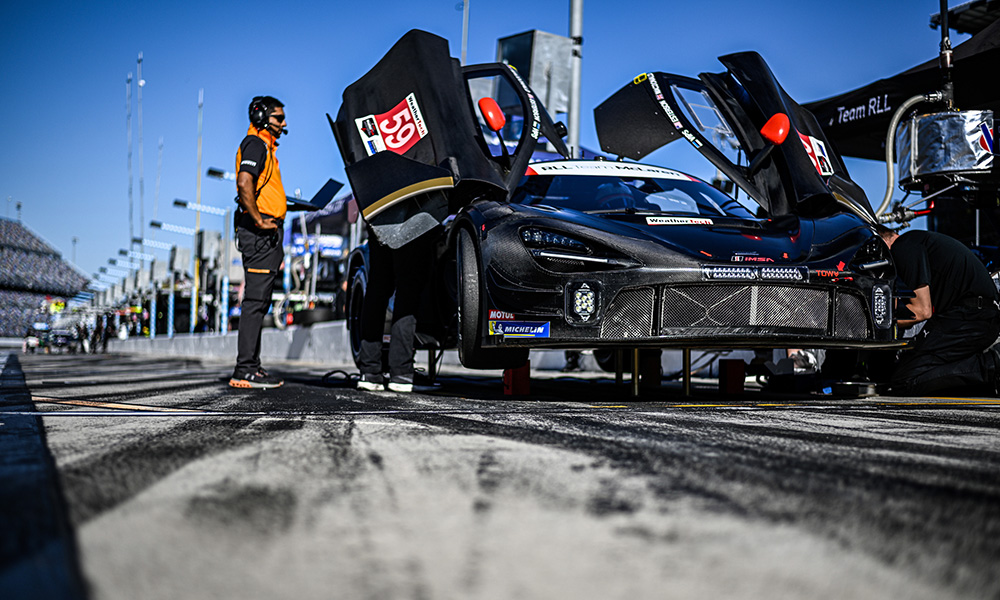
Photo: Brandon Badraoui/IMSA
IMSA has overhauled its testing rules for the 2027 WeatherTech SportsCar Championship season, reducing the amount of test days for GTP, LMP2 and GTD, while eliminating testing for GTD Pro entries altogether outside of the sanctioned or licensed tests.
Confirmed in the release of the 2027 sporting regulations, the change comes amid new licensed tests at Sebring International Raceway (Feb. 17-18) and Michelin Raceway Road Atlanta (Aug. 30-31), which join the IMSA-sanctioned test at Daytona International Speedway (Dec. 10-11), which are all eligible for all teams.
Private testing at Daytona, Sebring and Road Atlanta is now prohibited during a 120-day blackout period prior to each event, while third-party tests during circuit or holiday periods is also not allowed.
As previously defined, IMSA counts Easter, Memorial Day, Independence Day, Labor Day, Thanksgiving, as well as the period from Christmas Day to New Years Day, all as holidays, while teams will continue to be prohibited from testing 14 days following the last race of the season.
The one exception comes in LMP2, where teams can test for one day at Sebring between Feb. 1-March 9, inclusive, during the circuit blackout and would be deducted from its team test day allocation.
LMP2 and GTD teams, meanwhile, will continue to eligible to take part in third-party tests prior to the 14-day testing cutoff dates for each event outside of Daytona, Sebring and Petit Le Mans, although its allocations have been heavily reduced.
Test days, outside of the sanctioned and licensed tests, for LMP2 competitors have been reduced from 12 to eight days, while GTD has been slashed from six to two days, although two additional test days for FIA Bronze-rated drivers are still permitted.
The biggest changes come in GTP and GTD Pro, with the top prototype class only now permitted two manufacturer test days in a season, and manufacturer collective test days and team test days eliminated.
GTD Pro, meanwhile, has seen its six-day test allocation completely eliminated.
The blackout periods do not include participation in IMSA sanctioned or licensed tests, which do not deduct from the team test day allocation.
Other Notable Changes in 2027 Sporting Regulations:
***IMSA may “cancel” an accepted event entry at any time prior to the start of the event at its sole discretion, with such cancelations being conclusive.
***The use of wet weather tires during practice sessions is prohibited unless declared by the race director.
***A driver in the car who exceeds the maximum drive time during a red flag stoppage must be changed at the earliest opportunity following the resumption of the race.
***Red flag time is not counted in the four in six-hour maximum drive time calculation.
***A manufacturer must register only a single car model per class for manufacturer championship points eligibility at any one time during a season. A single manufacturer car model is only eligible for manufacturer championship points registration once during a season.
***New language around the determination of Balance of Performance has been added, stating the process to establish BoP may use a “combination of predictive and historical corrections” and that a rolling process “may be used to drive corrections from historical data.”
***Additionally, sources of information used in the BoP process include, but are not limited to: timing data, car data, homologation details, wind tunnel data, computational fluid dynamics data, center of gravity measurements and technical inspection records.
***Also, “Historical data may be filtered or sanitized for car damage, fuel load, power margin, race strategy, tire pressures, track condition, weather, driver performance, and driver weight.”
***The repeated changing of direction (weaving) for the purpose of warming or scrubbing tires is now prohibited on the first lap following the race start or on any restart.
***A competitor is now not allowed to “alter or modify” the condition of the car prior to technical inspection, including, but not limited to, causing the car to leave the racing surface and/or collect debris and/or foreign objects on the cool-down lap.
***Drivers are not permitted to use electronic glasses, with eyewear must be worn for the sole purpose of correcting eyesight and/or protecting glare. Drivers are subject to a minimum $1,000 fine if found to be wearing so-called smart glasses.
***Food service at transporters is limited to personnel directly supporting the team’s race operations, with third-party food services must be provided by track-authorized vendors “satisfying all track food service requirements.”
***The maximum awning widths have been adjusted, effective Jan. 1, 2028. Single-car teams must have 21-foot awnings, with two and three-car teams at 30 feet.